
Socle Therapy & Learning
Helping Individuals with Diverse Communication Needs
At Socle Therapy & Learning, we support children, teens and adults with a range of goals, including speech, language, literacy, stuttering, picky eating and swallowing. We support individuals with Developmental Language Disorder, Autism Spectrum Disorder, Intellectual Disability, Attention Deficit Hyperactivity Disorder, genetic syndromes, and other neurological conditions, as well as those who do not have any formal diagnoses. The summaries below outline what each area can look like day-to-day and typical supports we may discuss with you.
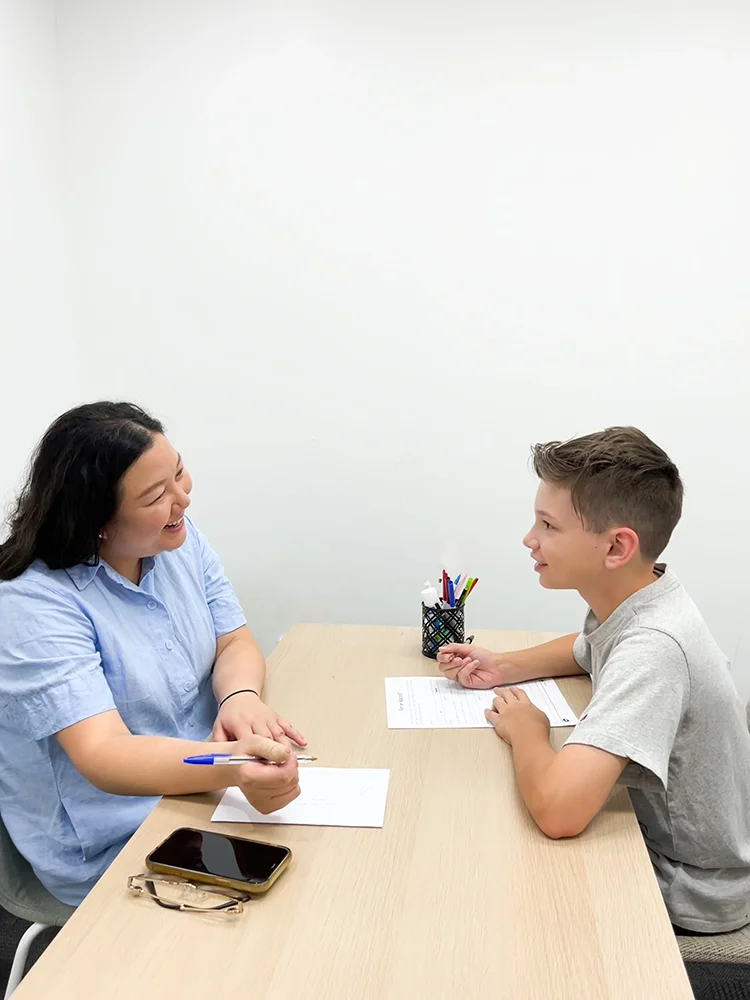


Language Skills (Understanding & Using Language)
Support for understanding instructions, building vocabulary, forming sentences, telling stories and managing classroom language demands.
Common goals may include:
- Following multi-step directions
- Forming long and/or grammatically complete sentences
- Retelling past events in sequential order
- Expanding vocabulary
Support may include: language stimulation, narrative work, grammar and vocabulary practice, visual supports, and coaching for families and teachers.
Reading & Writing (Literacy)
Assistance with reading accuracy, fluency and comprehension, spelling and written expression
Areas to increase skills may include:
- Reading fluently without sounding out each word
- Increased confidence with reading or writing tasks
- Planning and structuring written work
Targeted therapy could be focused on: phonemic awareness, phonics, decoding, morphology, comprehension strategies, and writing frameworks.

Speech Production Skills
Support for unclear speech due to sound error patterns, lisps, or Childhood Apraxia of Speech.
Common signs may include:
- Sounds substituted, omitted or distorted
- Reduced clarity in longer or complex words
- Inconsistent sound errors (common in CAS)
Support may include: sound placement teaching, motor-based practice, feedback, and home practice plans suited to daily routines.
Stuttering
Support for repetitions, prolongations and blocks across ages.
Common signs may include:
- Repeating sounds or parts of words
- Getting “stuck” on sounds
- Visible effort or tension when speaking
- Avoidance of certain words or situations
Support may include: age-appropriate stuttering programs, techniques to manage moments of stuttering, communication confidence building, and parent training where relevant.

Social Communication Skills
Support for understanding social cues, conversation flow and adapting communication across settings (home, school, work, community).
Areas to increase skills may include:
- Starting or maintaining conversations
- Understanding non-verbal social cues such as body language and facial expressions
- Interpreting figurative language e.g., idioms, sarcasm
- Building friendships
Support may include: social stories, perspective-taking tasks, role-plays, group or individual sessions, and strategies for classroom or workplace participation.
Picky Eating
Support for limited food variety, mealtime stress and sensory responses to food, in collaboration with families and other providers.
Common signs may include:
- Very small range of accepted foods
- Strong reactions to texture, colour or temperature
- Stress at mealtimes or refusal to try new foods
- Extended mealtimes or grazing pattern
Support may include: gradual exposure, sensory-aware approaches, mealtime routines, parent coaching and team-based planning.

Swallowing (Dysphagia)
Assessment and management of swallowing difficulties to support comfort and participation at mealtimes, consistent with medical advice.
Common signs may include:
- Coughing, choking or throat-clearing during/after meals
- Wet or gurgly voice quality after swallowing
- Recurrent chest infections
- Unexplained weight changes or fatigue at meals
Support may include: assessment, texture and fluid recommendations, positioning strategies, swallowing techniques, and liaison with other members of your allied health team.
Dementia (Cognitive–Communication & Mealtimes)
Overview: Support for changes in language, memory-related communication and mealtime participation linked with dementia.
Common signs may include:
- Word-finding difficulty and reduced conversation detail
- Trouble following multi-step information
- Repetition of questions or topics
- Changes to mealtime routines, pacing or interest in food
Support may include: communication partner training, memory aids and cueing, simplified language frameworks, meaningful activity-based conversation, mealtime routines, and collaboration with medical and care teams.

Parkinson’s (Speech & Swallowing)
Support for communication and swallowing changes associated with Parkinson’s.
Common signs may include:
- Reduced voice loudness or monotone speech
- Fast, soft or mumbled speech
- Fatigue when talking
- Coughing or throat-clearing with meals, prolonged mealtimes
Support may include: voice and breath support exercises, pacing and clarity strategies, communication partner training, and mealtime/texture strategies
Speech therapy services that may help you reach your goals
If you are looking for support regarding your communication or a loved one’s, please contact our friendly team. We will be happy to answer any questions and book an appointment for you.